
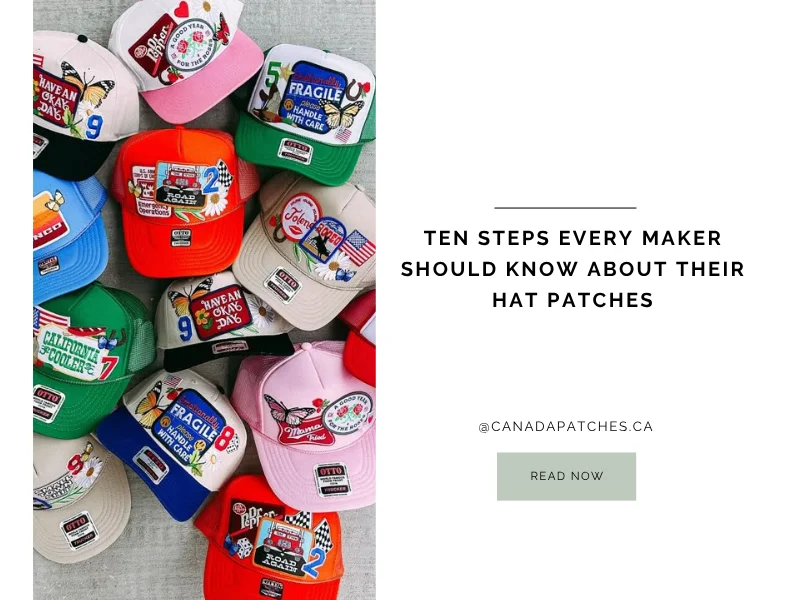
Creating Customized Hat Patches Made Simple in Just 10 Steps
If you are currently sourcing hat patches Canada-wide, you have likely encountered the bad ones. You know the ones with edges that curl after two weeks. Embroidery that looks like a blurry mess of nested threads, or leather that cracks and discolours the moment the weather changes to humid or freezing. So, what is to be done then?
There are two basic solutions to this trouble. Number one is that you create your own patches, and the second idea is to make sure you hire a professional who knows the 10 steps of patch making. Only then will you be able to achieve a high-quality result. This guide is about just that, so keep reading until the very end of it.
Building Custom Hat Patches That Don’t Peel Off
Speaking of hats, they themselves aren’t easy to deal with, mostly because of their unique, curvy shape. Unlike a flat t-shirt, a hat patch has to fight physics every time someone puts it on, takes it off, or tosses it into a gym bag. So, here is the step-by-step reality of the custom hat patch creation process. If you follow this, your patch will stay intact no matter what.
1. Simplify the Artwork
The most common mistake in the entire industry is trying to force a complex, digital website logo onto a physical badge. Get it straight in your head, once and for all: ‘Computers use pixels and patches use physical threads or moulds.’
This simply means that, different from the pixels, the thread has a fixed thickness. If your logo has razor-thin lines, tiny taglines, or complex gradients, the embroidery needle will punch too many holes in the same square millimetre of fabric. This will lead to a bird’s nest, which is a tangled clump of thread that ruins the structural integrity of the patch.
So, What Is The Solution Then?
Start by opening your logo on your phone, hold it at arm’s length, and then squint. If the text disappears or the icons blend into a blob, your design is too busy for a patch. Strip away the extra words and remove the shadows. A lot of well-known providers of Canada Patches are unaware of this trick, thus the ugly patches you receive.
2. Pick the Right Material for Survival
98 out of 100 times, the climate is the reason why a patch dies a terrible death. Who is to blame for this? Of course, not the weather, but the material choice. It shouldn’t just be about the vibe. Instead, it should be about surviving the environment the hat will live in.
| Style | Durability | Feel | Best Use Case |
| PVC | 10/10 | Rubberized/Flexible | Winter Gear & Workwear |
| Leather | 9/10 | Premium/Rugged | Breweries & High-End Retail |
| Woven | 7/10 | Flat/Sleek | Tech Startups & Fine Detail |
| Embroidered | 8/10 | Classic/Textured | Sports Teams & Uniforms |
3. Digital Mapping Phase
You don’t just print a patch without any background work. A human digitizer has to manually map out every single needle drop. They decide the path the machine takes.
This means that if the digitizer is lazy and sets the machine to run too fast, the patch will pucker. Or simply put, it will pull the fabric tight and create wrinkles that you can’t iron out.
A quick way to avoid this problem is to always ask your supplier for a stitch-out sample or a high-resolution digital preview. Then, in it, you look for density. If the stitches look loose or uneven, the patch will fray within a month of heavy use.
4. Choose the Border Based on the Hat Style
The next step is to analyze what border you want to do. It is the frame that keeps the patch from untying, but it also dictates how the patch sits on the hat.
· Merrowed Borders
These are the thick, wrapped edges you see on vintage police or scout badges. They are incredibly durable but very heavy. They work best on structured, high-profile trucker hats.
· Laser-Cut (Satin) Borders
These are flat and thin. They allow the patch to lie even against the fabric. If you are putting patches on unstructured dad hats or thin beanies, a laser-cut border is mandatory so the patch doesn’t pull the hat out of shape.
5. Sizing for the Golden Ratio
A badge that is too large will definitely make the hat look boxy and force the wearer’s forehead into an awkward shape. On the other hand, a patch that is too small looks like a cheap one. So, always aim for a standard 2.25 to 2.5 wide if it is a front badge.
Then it will fit perfectly in the center of the crown without hitting the seams. Though if it is a side patch, you need to keep it under 1.5 wide. Anything larger than that will rub against the wearer’s ear or temple, making the hat uncomfortable to wear for more than an hour.
6. A Backing That Stays Put
Most Hat Patches Canada orders come with a Heat Seal (iron-on) backing. Yes, it is a fact that modern adhesives are strong, but it is also worth remembering that they aren’t permanent in a country that swings from freezing outdoors to 22°C indoors. The constant temperature changes make the glue brittle over time.
So, Here’s the Pro Move!
First of all, use the heat seal to tack the patch into its perfect centred position. Then always finish it with a lock-stitch around the perimeter. That physical thread is the only thing that guarantees the patch won’t start winging (corners popping up) six months down the line.
7. Sampling & Colour Matching
Threads are dyed in batches, and they never look exactly like your computer screen. An Office Blue on your monitor might look like Electric Purple when stitched with shiny polyester thread.
Thus, the next step is to make sure that if your brand colours are non-negotiable, ask your supplier for the Pantone thread match. Better yet, ask for a photo of the actual thread spools sitting next to the hat fabric you have chosen. Lighting changes everything.
8. The Curvature Problem
Hats are rounded, and the patches are flat. Therefore, if your patch material is too thick or stiff (like heavy 5mm leather), it will fight the curve of the hat. Eventually, the tension will win, and the patch will peel. A secret you need to know is that, for leather or PVC, make sure to ask for a thinned or bevelled edge. This makes the perimeter of the patch more flexible so it can wrap around the crown’s curve without resisting the adhesive or the stitches.
9. Industrial Heat Pressing vs. Home Irons
Now speaking of the iron pressing, it is important to understand that you cannot properly attach a professional patch with a household iron. An iron provides uneven heat and zero pressure. Hence, to get a permanent bond, you need a curved hat press that applies 300°F+ of heat and 60psi of pressure simultaneously from the top and the bottom.
10. The Final Tension Check
In the end, once the patch is attached and has cooled down completely, use your thumb to try to flick the edge of the patch. If you see even a hairline gap between the patch and the hat, the bond is weak. A perfectly applied patch should feel like a single, solid piece of gear. There should be no crunchy sound when you flex the hat, and no loose threads hanging at the border.
FAQs
How can I prevent my custom hat patches from peeling off in cold weather?
You should avoid relying on iron-on adhesive alone. Instead, always use a perimeter lock-stitch to mechanically secure the badge.
Which badge material is best for high-detail logos with small text?
You should choose woven patches over embroidered ones, as they use thinner threads that prevent small letters from bleeding together.
Why should I avoid using a standard household iron for hat badges?
Household irons lack the consistent 60psi pressure and curved heating plates required to bond the adhesive into the hat’s buckram.
Conclusion
In the Canadian market, people have a high standard for outdoor gear. They literally live in their hats. So, if you provide a product where the patch starts to lift after the first rainstorm, it doesn’t just look bad for the hat. It looks bad for your brand.
The blog above had all the significant details of how to build a custom hat patch that lasts for years. You should go through it at least twice and save yourself from repeating mistakes and being conned by a patch provider in the future.

I am the creative voice behind CanadaPatches.ca, turning complex patch designs and branding ideas into simple, easy-to-follow solutions. My blogs explain customization processes, material choices, and ordering tips in a practical way. I focus on helping businesses and individuals build strong brand identities. My goal is to make custom patch creation clear, confident, and stress-free.